Stay informed with our latest insights, research, and updates.
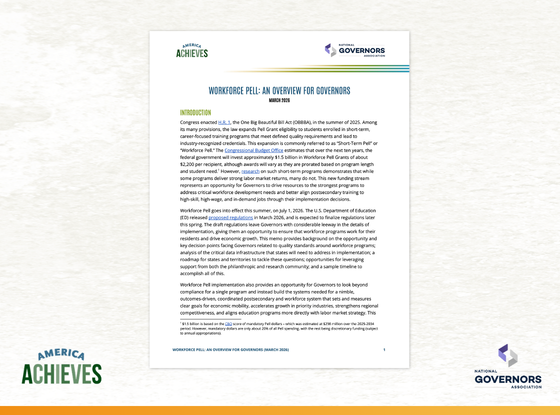
A collection of practical resources from America Achieves to help states prepare for Workforce Pell
Beginning in July 2026, H.R. 1 — enacted by Congress last year — will take effect, creating “Workforce Pell” and expanding Pell Grant eligibility to short-term, career-focused training programs that meet defined quality requirements. Research shows that while some programs generate strong labor market returns, many do not — and better outcomes are not automatic. Success will require governors to lead in the coming months with a sharp focus on good, in-demand jobs, and on ensuring those jobs actually deliver real economic independence.
Seizing the opportunity. The urgency and opportunity are both real. Governors have substantial authority to set the standards in their states for this new Workforce Pell funding that will begin flowing later this year, and to leverage the opportunity to better align quality standards and outcomes measures across workforce funding streams. To do so, governors do not need to rush to approve programs, but should instead take the time to thoughtfully set standards, build processes, establish needed data infrastructure, and roll out the program over the coming months and years.
To help states prepare for Workforce Pell, America Achieves, in partnership with the National Governors Association, is developing a library of resources, including playbooks, fact sheets, and other guidance. States can use these tools to drive toward smart implementation of this program, while taking steps to modernize their education and workforce systems more holistically.
We’ll be publishing materials throughout spring and summer of 2026. This roll-out will provide responsive, current information. We are grateful to our partners at JPMorganChase for funding this work.
Published March 11, 2026
This memo provides governors with:
Published May 7, 2026
A series of one-page briefs describing key standards and definitions that Governors, in consultation with their state workforce boards, will need to define and operationalize when implementing the Workforce Pell program. Briefs include information on what is required by statute, where states may have existing definitions, and considerations for high-quality implementation:
Published May 7, 2026
Ahead of the July 1, 2026 start date, and in order to leverage the opportunity that Workforce Pell presents to expand economic mobility, address employer demand, and advance the broader modernization of their education-to-workforce systems — this playbook provides state leaders with a timeline and a roadmap to:
Published May 7, 2026
This memo details how Governors and training providers can ensure that Workforce Pell programs convert into academic credit that can stack and transfer toward certificates and degrees — as required in the statute. It includes helpful information and analysis regarding:
It also includes a checklist for Governors to ensure that programs are part of a student’s ongoing career pathway.
Published April 29, 2026
This memo provides researchers and states with:
Published April 13, 2026
This memo provides philanthropic leaders with:
Published March 18, 2026
This blog post includes:
In the coming weeks and months, we will publish additional practical resources here, including details on data infrastructure, guidance to leverage state funding, and a dictionary of Workforce Pell-related terms, among other materials. We invite you to subscribe to our mailing list to stay tuned.
Get Involved: We welcome conversations from any governor’s office, state workforce leader, nonprofit, or philanthropic partner. Contact us at info@goodjobseconomy.org.

Announcing the launch of Good Jobs Western North Carolina, workforce tools to support state leaders, and new private and philanthropic investments
Today at the ASU+GSV Summit, national nonprofit America Achieves announced progress on its Good Jobs Economy initiative, which launched last summer with National Governors Association (NGA) Chair and Oklahoma Governor Kevin Stitt and NGA Vice-Chair and Maryland Governor Wes Moore. New progress includes:
America Achieves CEO Jon Schnur announced these during a main stage ASU+GSV Summit panel on “A New American Talent System for an AI-Disrupted World,” moderated by Schnur, featuring Professor Joseph Fuller, Professor of Management Practice at the Harvard Business School; Alison Griffin, Principal at FutureRise; and MC Belk Pilon, President and Board Chair of the John M. Belk Endowment.
This progress advances America Achieves’ commitments to help states build Good Jobs initiatives and funds—which will back and scale effective good jobs programs—and modernize talent systems. Together, these commitments are advancing practical, outcomes-focused strategies that connect more people to good jobs.
North Carolina Governor Josh Stein said, “Good Jobs WNC will help create an economy that better connects people to opportunity, strengthens our communities, and ensures our employers find the talent they need to grow…in high-demand sectors like health care, manufacturing, and the skilled trades.”
Governor Stein also invited national funders to join an in-person summit of North Carolina funders and partners later this year, saying,
“If you want to be a part of something special, led by bipartisan local leaders, focused on building durable pathways to economic mobility, strengthening rural communities, and helping a dynamic region recover by connecting people to good jobs, you should take a close look at what is happening in Western North Carolina.”
America Achieves CEO Jon Schnur said, “More leaders across the U.S., including in North Carolina, are confronting the systemic disconnect between two unmet needs at large scale: employers looking for talent in high-growth sectors, while workers and students seeking good jobs and sustainable opportunities in a rapidly changing economy to translate hard work into self-sufficiency. But this can only happen where governors, employers, place-based regional initiatives, and philanthropy act decisively and together.”
Good Jobs WNC is a locally led, regionally coordinated, and nationally connected effort that brings together all 11 community colleges across 23 counties, employers, leading foundations, and regional partners around two shared goals:
"At the Belk Endowment, we've learned over more than a decade that progress moves at the speed of trust. Good Jobs WNC started with showing up in communities across Western North Carolina, listening to community college presidents, employers, and local leaders, and asking what it would take to build something lasting. What's emerged is a coordinated effort and locally driven coalition that responds to urgent needs after Helene while laying the foundation for a workforce system this region can count on for decades to come," said MC Belk Pilon, President and Board Chair of the John M. Belk Endowment, a leading funder and Good Jobs WNC steering committee member.
Good Jobs WNC has secured $2.5 million and is on track to secure $6 million in in-state funding for this initiative—and is looking to secure an additional $6 million in national funding. Governor Stein is proposing $600,000 for this initiative to the North Carolina legislature. Those resources will help capitalize the Good Jobs Program Fund, expand proven training pathways, and build the long-term regional infrastructure required to turn recovery into lasting economic mobility.
In the aftermath of Hurricane Helene, which caused nearly $60 billion in economic damage and exposed the fragility of the region’s economy, the region faces both urgent recovery needs and a rare opportunity to build a stronger, more coordinated system to help residents access good jobs and employers access skilled talent.
Governors and states are making critical decisions in the coming months about the new Workforce Pell program enacted by Congress last year. Today, America Achieves released recommendations for how philanthropy can help maximize prospects of this new federal initiative.
Philanthropic organizations can play a pivotal role in the success of Workforce Pell, helping support states that commit to effective, outcomes-driven implementation—especially if philanthropy moves quickly and effectively.
This new brief for philanthropy adds to a library of several Workforce Pell resources published last month, including recommendations that America Achieves and NGA developed for governors, as well as a blog post from America Achieves that summarizes recommendations to governors and philanthropy. America Achieves and NGA will be publishing additional Workforce Pell materials throughout the spring and summer of 2026 to share current, actionable information.
These materials build on work with Governor Wes Moore’s administration in Maryland, where America Achieves partnered with state workforce and postsecondary leaders to provide technical assistance in utilizing the governor’s authority for implementation.
Today’s brief recommends that philanthropy take urgent steps to incentivize and support states to make Workforce Pell a success. These include:
Taken together, these strategies can help ensure Workforce Pell generates stronger standards, better outcomes, and more durable pathways to good jobs—and reduce the risk that Workforce Pell fails to accomplish these goals. This work creates an opportunity to test how philanthropic dollars can complement public funding more directly—helping expand access to the highest-quality programs, address barriers that public dollars do not fully cover, and generate practical models that states can refine and scale.
The overall package of tools for governors shared by America Achieves and NGA is designed to be action-oriented and help governors:
Those materials are intended to help governors move quickly—while keeping standards high and accountability clear.
“Workforce Pell will only be as effective as states are strategic in their implementation of the program,” said Jen Mishory, Senior Advisor at America Achieves. “These tools are designed to help governors use their authority to align funding with real labor-market demand and program outcomes.”
“Philanthropy can play a pivotal role in shaping the success of Workforce Pell state-by-state, and in some cases, it already is,” said America Achieves CEO Jon Schnur. “To do so, philanthropy will need to act quickly, effectively, and collaboratively.”
The Good Jobs Economy is built on the premise that stronger pathways to good jobs require sustained partnership across governors’ offices, employers, education and training providers, philanthropy, and regional leaders. At ASU+GSV, America Achieves announced a new national partner whose support will help advance this critical work.
The Best Buy Foundation joins the initiative as a national employer partner, contributing grant funding and executive leadership support to help grow Good Jobs Funds. Their commitment showcases the importance of employer leadership in shaping industry-aligned training pathways that lead to career advancement. Through their support, we will also advance efforts that connect young people and adults to training and career opportunities aligned with real labor market demand, including in emerging regional strategies.
“As part of our mission, the Best Buy Foundation is focused on building strong talent pipelines and empowering young people across the country with the skills they need to discover their potential and step into career paths that lead to economic opportunity,” said Olivia Jefferson, Executive Director of the Best Buy Foundation and Vice President of Social Impact at Best Buy. “We’ve seen firsthand how powerful it is when young people are given the skills, support and confidence to follow a clear path to success and we’re proud to collaborate with so many great organizations through this initiative to build a workforce ready to lead the future.”
“When we launched the Good Jobs Economy, we made a commitment to help governors build more demand-driven talent systems and to create practical pathways that connect people to good jobs,” said Jon Schnur, CEO of America Achieves. “We are proud to demonstrate early progress on both and to welcome the Best Buy Foundation as an important partner helping us and governors across the county achieve lasting impact.”
This investment highlights the catalytic role of private and philanthropic capital in advancing the Good Jobs Economy. By providing flexible, early-stage funding, partners like the Best Buy Foundation help states and regions move quickly to build and scale high-quality, employer-aligned programs and generate proof points for what works.
Together, this approach ensures that new funding streams, including Workforce Pell, are directed toward programs that deliver real results for workers and employers alike.
America Achieves is a national nonprofit organization working with states, regions, and local partners to ensure more people have clear pathways to good jobs, regardless of who they are, where they live, or whether they have a college degree. Founded in 2011 as an action tank, America Achieves operates at the intersection of policy design, systems building, and on-the-ground implementation. Through its Good Jobs Economy initiative—in collaboration with the Chair’s Initiative of the National Governors Association—and partnerships with states, regional intermediaries, and education and workforce leaders, America Achieves helps design, launch, and scale initiatives that align workforce, education, and economic development strategies to deliver measurable regional outcomes.
Over the past decade, America Achieves has helped design more than $2 billion in bipartisan economic and workforce programs, including the Good Jobs Challenge, Build Back Better Regional Challenge, and Regional Tech Hubs. In addition, America Achieves has worked with dozens of communities to develop plans and applications that have resulted in approximately $250 million in funding for local partners. The perspectives shared below reflect sustained engagement with regions as they translate federal investments into durable economic opportunity.
Recommendations for states and philanthropy to leverage this new federal funding stream
Beginning in July 2026, H.R. 1 — enacted by Congress last year — will take effect, creating “Workforce Pell” and expanding Pell Grant eligibility to short-term, career-focused training programs that meet defined quality requirements. Research shows that while some programs generate strong labor market returns, many do not — and better outcomes are not automatic. Success will require governors to lead in the coming months with a sharp focus on good, in-demand jobs, and on ensuring those jobs actually deliver real economic independence.
Seizing the opportunity. The urgency and opportunity are both real. Governors have substantial authority to set the standards in their states for this new Workforce Pell funding that will begin flowing later this year, and to leverage the opportunity to better align quality standards and outcomes measures across workforce funding streams. To do so, governors do not need to rush to approve programs, but should instead take the time to thoughtfully set standards, build processes, establish needed data infrastructure, and roll out the program over the coming months and years.
Below are America Achieves’ top recommendations for how governors can leverage Workforce Pell to advance good jobs outcomes in states.
Higher education and workforce programs have too often been organized around activities — seat time, enrollment, even completion — rather than the outcomes those activities are supposed to produce. Governors should establish a clear north star for everyone working on this: the goal is good jobs that pay a living wage, enabling genuine self-sufficiency and economic independence. Every decision about program approval, standards, and accountability should be evaluated against that outcome.
To make the standard concrete and defensible, governors should anchor key definitions, such as the requirement that programs align to a high-wage, high-skill, or in-demand job, around wage baselines — such as the MIT Living Wage Calculator, for example — so that what counts as a living wage reflects real costs in real communities rather than a flat statewide number. Federal law sets the floor just above the poverty line, which falls far short of what it actually takes to support a family. States that simply accept that floor risk treating any job just above poverty as success. Programs should be approved only if they prepare people for good jobs that meet that standard directly, or are real, stackable, documented pathways landing participants in programs that do.
Governors will need to own this outcome themselves, especially for the next four years, because federal accountability on value-added earnings — a relatively low bar to start — will likely not go into effect until 2030, due to a statutory requirement that earnings be measured for students who completed programs three years prior to each award year. The Department of Education has asked in the NPRM for feedback on how to address the question of ROI in the first several years. But the NPRM makes clear that governors have the authority, from the very start, to approve programs based in part on anticipated return on investment, and to make wage and earnings data publicly available before federal measures kick in. Governors who act on both will drive Workforce Pell toward good jobs from day one.
States are not required to be fully operational on July 1 — programs can come online throughout the 2026–27 award year and beyond. A state that rushes to approve a large portfolio with weak standards will spend years dealing with the consequences. Initial standards are also not permanent: nothing prevents a state from updating quickly if early data reveals problems.
Governors should require that programs demonstrate real employer validation. While the law envisions employer input in multiple places, requiring states to approve programs that are in-demand, that meet “employer hiring needs”, that lead to industry-recognized certificate or certification (or state licenses or Registered Apprenticeships) — and that employers help validate the portability and stackability of programs — governors still have considerable room to define how they meaningful capture that input across requirements. We recommend that governors require serious employer validation of programs in order to be approved, including strong validation such as commitments to interview or hire program completers. At the very least, governors must require employers to confirm that a specific program is aligned to skills and roles those employers project they will actually be hiring for. Evidence of engagement is not enough; what matters is whether employers have put their name behind the program as a genuine pipeline for real jobs.
States should ensure a regularly updated understanding of not just what jobs are in-demand — but what specific skills and competencies employers are actually seeking. This means drawing on real-time data sources, including job postings and employer surveys, and validating findings directly with employers — covering not just roles being filled today but the sequence of predictable roles in an industry over time. This kind of intelligence can drive effective Workforce Pell implementation and help focus workforce systems statewide on jobs and skills that matter.
Governors should also factor in longer-term trends. Many sectors facing the greatest near-term retirement-driven hiring needs — including health care, advanced manufacturing, and the skilled trades — are also projected to face less near-term exposure to AI displacement, making them strong candidates for durable credential pathways. Governors should supplement real-time labor market data with the best available projections of how AI will reshape local labor markets, and prepare now by identifying at-risk occupations in advance, so that when displacement happens, short-term credentials are already serving as clear on-ramps to more durable careers, connected to and complemented by longer pathways where needed.
Governors should use this as an opportunity to start or strengthen the setting, measuring, and tracking of goals for labor market outcomes–including but beyond Workforce Pell. To make this possible, states need to link labor market outcomes data to non-credit programs, verify if program graduates are employed in fields related to their training by integrating Standard Occupational Classification (SOC) codes, and better understand if program graduates pursue or complete relevant further education by collecting information on credit transfer and articulation agreements. Many states lack the ability to do these. But consequences and transparency on outcomes matter and making this a reality requires these steps.
The standards, data systems, and employer relationships built for Workforce Pell can form the foundation of the infrastructure a state needs for a nimble, outcomes-driven workforce system positioned to respond as AI reshapes labor markets. Governors should designate a cross-agency working group with a mandate that goes beyond Workforce Pell compliance. America Achieves’ six interdependent elements of an effective state talent system provides a practical structure for that work. We have been collaborating in Oklahoma to use this framework to carry out a diagnostic on Oklahoma’s statewide strengths, areas of development, and priority actions. We are partnering with Governor Moore’s team in Maryland to provide technical assistance as it implements Workforce Pell in the state.
Governors should also use this moment to task their working group with a broader data system overhaul — enhanced wage records, improved integration across labor market data sets, and the analytical capacity to use that data to drive decisions and action, not just collect it.
We recommend that the philanthropic community actively incentivize and support states that set high standards and commit to effective, outcomes-driven implementation. This includes:
Federal law and the draft regulations require that Workforce Pell programs be stackable — connected to additional credentials and portable across employers, so workers can keep building skills and wages over time rather than stopping at a single certificate. But requiring stackability and building the architecture that makes it real are two different things. Philanthropy can invest in the design and coordination work that turns a sequence of programs into a genuine career launch, including earn-and-learn models, articulation agreements, and advising infrastructure. Philanthropy can also fund the student navigation infrastructure that research shows makes the difference between a credential that leads somewhere and one that doesn’t. In North Carolina, America Achieves’ Good Jobs Fund is helping community colleges — including in communities hit by Hurricane Helene — build and modernize programs culminating in good jobs and meeting high standards including those associated with Workforce Pell.
Many strong programs won’t qualify at launch because they haven’t existed for the required year or lack historical outcomes data. Philanthropy can bridge that gap — seeding new evidence-informed, data-driven programs and helping existing ones build the track record of quality needed to qualify.
Workforce Pell creates an opportunity for both natural experiments across 50 states, and for the design and funding of randomized control trials that evaluate program design. Philanthropy can support those types of efforts, covering evaluation infrastructure costs that states and programs rarely have resources to build themselves, as well as longitudinal outcome tracking and findings disseminated in forms policymakers can actually use. Engaging researchers early on is far more effective in tracking and improving results than retrofitting evaluation after the fact.
Philanthropy can also fund the labor market intelligence states need to identify in-demand jobs, knowledge, skills and competencies to inform what constitutes genuine employer hiring needs and where this funding can best address them. This should focus on specific industries with the greatest concentration of hiring needs for good jobs and upwardly mobile careers.
Philanthropy should take the lead by putting more dollars into the programs getting the best results, incentivizing them to expand, and using rigorous research to build the evidence base that supports others to adapt those programs elsewhere. What starts as a philanthropic proof point becomes a replicable model others can adopt at scale. Governors should consider aligning public funding incentives in the same direction.
Governors have clear authority to set the bar higher than required by the federal statute. Philanthropy can support high standards by directing resources, technical assistance, and recognition to states that set ambitious quality standards and build genuine interim accountability on wages which will create a direct incentive for states to raise the bar.
For more guidance and materials, view America Achieves' Workforce Pell resource library.
Get Involved: We welcome conversations from any governor’s office, state workforce leader, nonprofit, or philanthropic partner. Contact us at info@goodjobseconomy.org.


.png)
Good Jobs Economy is a centerpiece of Incoming National Governors Association (NGA) Chair Governor Kevin Stitt’s “Reigniting the American Dream”
FOR IMMEDIATE RELEASE
Contact: kristy@goodjobseconomy.org
July 30, 2025 — Today, the national nonprofit organization America Achieves launched Good Jobs Economy partnerships to work alongside governors, states, and local regions to connect residents to good jobs while helping employers access skilled talent. The goal is to help hundreds of thousands of Americans reach and stay in the middle class by accessing good jobs and advancing their careers. These partnerships build on America Achieves’ prior work helping local regions advance economic and workforce development.
Oklahoma Governor Kevin Stitt announced his NGA Chair’s initiative, Reigniting the American Dream, and introduced Good Jobs Economy as a core partner in the initiative’s work to modernize talent systems and launch good jobs funds. Governor Stitt and Maryland Governor Wes Moore, NGA’s Vice Chair, announced that Oklahoma and Maryland will be the first states to work with Good Jobs Economy to scale effective programs and modernize talent systems — and prepare to make effective use of newly enacted Workforce Pell Grant funding. Workforce Pell was recently enacted by Congress to help students, for the first time, pay for short-term job training programs starting July 1, 2026; this new law also empowers governors to shape which programs in their state are eligible for workforce Pell funds. Our initial work in Oklahoma and Maryland will expand to support additional states while creating playbooks and tools to help other interested states and communities launch Good Jobs Funds, modernize talent systems, and best leverage Workforce Pell funding.
“A Good Jobs Economy is essential to reigniting the American Dream. This year, I am challenging every governor to build strong bridges between millions of Americans seeking good jobs and the employers eager to hire them. We need to think boldly and act urgently,” said Governor Stitt. In his remarks at the NGA summer meeting, Stitt said, “I’m going to partner with organizations like Good Jobs Economy…to help states build modern talent systems–ones that connect people to real opportunities.”
“We are excited to partner with Good Jobs Economy, launched by America Achieves as part of the National Governors Association Chair’s Initiative, to expand access to high-quality jobs for more Marylanders,” said Governor Moore. “We'll deploy state, philanthropic, and federal funding to scale what works, modernize our talent systems, and ensure Marylanders can access good jobs while giving employers the talent they need.”
“This effort is about turning economic promise into real opportunity,” said Jon Schnur, CEO of America Achieves. “It’s about expanding the middle class, and ensuring businesses can build and grow by accessing the talent they need, and ensuring that more Americans can achieve the dignity and security of a good job.”
Across the country, employers face talent shortages, including more than 2 million unfilled manufacturing jobs projected by 2030, threatening over $1 trillion in economic output. At the same time, nearly half of full-time workers don’t earn enough to be self-sufficient. For many young people, the path forward feels out of reach: 60 percent say the American Dream is either not real or unreachable, according to the Broken Marketplace study. Meanwhile, AI and other technologies are accelerating workforce changes faster than current systems and strategies are adapting.
In response to this need, Good Jobs Economy will work in close partnership with Oklahoma and Maryland, and other select states and local regions, to draw on that work and lessons learned into practical playbooks, tools, and other resources shared through a national learning network. We will leverage the data, research, and insights from these early efforts to help governors and cross-sector coalitions launch Good Jobs Funds and modernize talent systems that deliver real results:
Create and Scale Good Jobs Funds. These funds will identify and fund the development, and growth of evidence-based, scalable models that connect employers, job seekers, and education and training providers in local regions. Our goal: 10,000 people identified, trained, and hired into good jobs by 2030.
Modernize talent systems. These talent systems will scale and sustain pathways to good jobs, give employers access to the skilled talent they need, and advance economic development and national security. Our goal: connect hundreds of thousands of people to good jobs over a decade, earning billions in additional wages. This intensive work with states and regions will build the evidence base on what works and inform playbooks and tools that communities across the country can use to guide their work. These statewide talent systems will:
As part of this effort, Oklahoma is launching a Good Jobs Fund with an initial commitment of $19 million to identify, develop and grow successful programs in Oklahoma. This includes $4.5 million in existing public funds through the Oklahoma Workforce Commission for high-impact programs. Additionally, the George Kaiser Family Foundation is committing at least $15 million in aligned funding to prepare residents of Tulsa for good-paying jobs in industries like manufacturing, advanced air mobility, and healthcare. These investments are designed to catalyze larger philanthropic and public funding to create pathways for Oklahomans to reach and stay in the middle class. Governor Stitt will issue an executive order to prepare Oklahoma to make effective use of newly enacted Workforce Pell Grant funding and is expected to establish a task force to develop a statewide implementation roadmap for Workforce Pell in Oklahoma. Read the Oklahoma Fact Sheet →
Maryland will identify and fund the development, implementation and growth of evidence-based, scalable programs and pathways that train and place residents into good local jobs in high-demand sectors such as healthcare, information technology, cybersecurity, life sciences and aerospace. This will include $25 million in public funding through Governor Moore’s nationally recognized EARN program and the Registered Apprenticeship Investments for a Stronger Economy (RAISE) Act, $15 million in aligned philanthropic funding, with additional public and private investments to be made in the future. Maryland’s strategy includes building a revolving workforce fund to support low-cost nursing pathways, a statewide strategy for high school career counseling, and employer connections for underrepresented tech talent, and improving high school career counseling.
Maryland will also partner to build a more integrated and responsive talent system that adapts more quickly to changes in the job market and supports inclusive economic growth. At the same time, the partnership will develop a policy framework and process designed to ensure the effective deployment of recently expanded Pell Grants that become available July 1, 2026 for short-term workforce training programs. Read the Maryland Fact Sheet →
Good Jobs Economy is a bipartisan effort launched and operated by the national nonprofit organization America Achieves, in partnership with the Chair’s initiative of the National Governors Association. Its work is grounded in America Achieves’ experience with regional economic and workforce intermediaries, leading policymakers, and other experts. Over the last ten years, America Achieves has:
Philanthropic funding for the planning and early stages of Good Jobs Economy has been provided by Blue Meridian Partners, the George Kaiser Family Foundation (GKFF), MacKenzie Scott, Strada Education Foundation, and others. This effort builds on America Achieves’ efforts to help Tech Hub applicants develop their plans — funded by the Mastercard Center for Inclusive Growth, GKFF, and others. We are in active discussions, and welcome additional conversations, with national and in-state funders to support scaling the Good Jobs Economy work and partnerships.
Today, Maryland Governor Wes Moore announced a partnership with Good Jobs Economy.
“We are excited to partner with Good Jobs Economy, launched by America Achieves as part of the National Governor’s Association Chair’s Initiative, to expand access to high-quality jobs for more Marylanders,” said Moore. “We’ll deploy state, philanthropic, and federal funding to scale what works, modernize our talent systems, and ensure Marylanders can access good jobs—while giving employers the talent they need.”
The Moore-Miller Administration will prioritize workforce development in high-demand sectors such as health care, information technology, cybersecurity, life sciences, and aerospace.
Investing in High-Quality Programs
Governor Moore will identify and fund the development, implementation, and growth of evidence-based, scalable programs and career pathways that train and place residents into good local jobs – especially in priority industries and occupations. This will include $25 million in public funding through Governor Moore’s nationally recognized EARN program and the Registered Apprenticeship Investments for a Stronger Economy (RAISE) Act, $15 million in aligned philanthropic funding, with additional public and private investments to be made in the future focused on the industries and sectors prioritized by the Moore-Miller Administration and employers.
The $15 million in committed private sector funding over three years is to support innovative, high-impact workforce development initiatives that include the creation of a revolving workforce fund to support low-cost nursing pathways, a statewide strategy for high school career counseling, and stronger employer connections for underrepresented tech talent.
Over the next two years, the Administration expects to support over 14,000 Marylanders to enhance their job skills to prepare workers for good jobs in select high-growth industries and high-demand occupations, focusing on programs with close employer partnerships and on specific jobs and skills identified as priorities by leading employers. The funding will help develop, modify, and scale programs to keep pace with employer hiring needs as well as support implementation. They will also measure and evaluate the impact on outcomes, including job attainment, wage gain, and earning employer-valued credentials. Results of these programs will inform future state policy design.
The EARN program equips residents with in-demand skills and has demonstrated a return of more than $18 for every $1 invested. To date, it has engaged over 1,200 businesses and helped more than 10,000 workers access meaningful employment. The RAISE Act builds on this success by expanding access to Registered Apprenticeships and creating new pathways to good, family-sustaining jobs.
Building Talent Systems
In addition, Governor Moore will partner with Good Jobs Economy to build a more integrated and responsive talent system that adapts more quickly to changes in the job market and supports inclusive economic growth. This system will use data, technology, and updated curriculum and training opportunities to equip Maryland’s workforce for the jobs of the future.
At the same time, the partnership will develop a policy framework and process designed to ensure the effective deployment of recently expanded Pell Grants that become available July 1, 2026 for short-term workforce training programs.
To support these goals, the partnership will assess and lay the foundation for how the state:
For more information, please reach out to Special Assistant to the CEO, Kristy King-Pritzl at kristy@goodjobseconomy.org.
An overview of Oklahoma's partnership with Good Jobs Economy to help put thousands of Oklahomans in good jobs and transform state systems to build a workforce that powers the state’s economy into the future
To do this, Governor Stitt: 1) announced an Oklahoma Good Jobs Fund to support high-quality workforce training for priority industries, 2) is launching an effort to assess and improve the state’s talent systems, and 3) plans to issue an executive order to ensure the state is ready to provide high-quality training options that leverage new Pell Grant funding for short-term programs.
The Oklahoma Good Jobs Fund
Governor Stitt is announcing an Oklahoma Good Jobs Fund to identify and fund the development, implementation, and growth of evidence-based, scalable programs and industry partnerships that train and place residents into good local jobs — especially in priority industries and occupations. This fund includes $4.5 million in public funds to support high-quality programs statewide, and at least $15 million from the George Kaiser Family Foundation in aligned funding to prepare Tulsans for good jobs in industries like manufacturing, advanced air mobility, and health care. These investments are designed to catalyze larger philanthropic and public funding to create pathways for Oklahomans to reach the middle class.
The purpose of this funding is to prepare workers for good jobs in select high-growth industries and high-demand occupations. The funding will help develop, modify, and scale programs to keep pace with employer hiring needs — while measuring and evaluating the impact on outcomes, including job attainment, wage gains, and earning of employer-valued credentials. Results of these programs will inform future state policy design.
As a part of this launch, Governor Stitt is utilizing the Oklahoma Workforce Commission and building off the newly formed Workforce Transformation Fund as the mechanism for a Good Jobs Fund in Oklahoma.
Building Talent Systems
In addition, Governor Stitt will partner with Good Jobs Economy to build a more integrated and responsive talent system that adapts more quickly to changes in the job market and supports inclusive economic growth. This system will use data, technology, and updated curriculum and training opportunities to equip Oklahoma’s workforce for the jobs of the future. To support these goals, the partnership will assess and lay the foundation for how the state:
Implementing Workforce Pell
Finally, Governor Stitt will issue an executive order to prepare Oklahoma to make effective use of newly enacted Workforce Pell Grant funding, which will help students pay for short-term job training programs starting July 1, 2026. His executive order is anticipated to establish a task force to develop a statewide implementation roadmap for Workforce Pell — taking into account any guidance or regulations issued by the U.S. Department of Education — to:
For more information, please reach out to Special Assistant to the CEO, Kristy King-Pritzl at kristy@goodjobseconomy.org.